Best Salsa Dance Shoes for Men: Complete Guide, Reviews, and Buying Tips
Most guides about salsa dancing focus on moves, timing, and partnerwork. All important. But footwear is where technique meets reality.
If your shoes fight you, your dance gets noisier, heavier, and less precise. If your shoes match your level and your goals, your balance improves, your spins become more consistent, and your feet survive longer social nights.
This article is a deep review of men's salsa dance shoes from a real dancer's perspective. It is built around years of trial and error, from heavy street shoes to split-sole sneakers to modern suede shoes designed for social dancing and performance. The goal is simple: help you choose the right shoe for where you are now, not where you hope to be six months from now.
If you are searching for terms like best salsa dance shoes for men, salsa shoes for beginners, men's suede sole dance shoes, best shoes for salsa spins, or what shoes to wear to salsa class, this guide is written for you.
Quick answer: what should most men buy first?
For most beginners and early intermediates, the best first dance shoe is usually one of these:
- A low-profile jazz shoe (budget-friendly, very light, great floor feel).
- A practice sneaker with controlled pivot points (more support, slightly less spin freedom).
- A modern suede salsa shoe (best long-term option if budget allows and you dance often).
If you only remember one thing from this article, remember this: good dance shoes support good technique, but they do not replace it.
The shoe progression most male salseros go through
Many men start with whatever they already own, then slowly optimize as their dancing improves.
A common progression looks like this:
- Street shoes
- Dance sneakers (Bloch-type split sole)
- Jazz shoes
- Latin ballroom shoes
- Fashion-forward social shoes (pointy or hard sole)
- Modern suede salsa shoes
You do not need to follow this exact sequence. But understanding the tradeoffs at each step will save you money and prevent avoidable injuries.
How to evaluate salsa dance shoes for men
Before reviewing categories, use this checklist. It helps separate "looks good" from "actually helps me dance better."
1. Sole material and friction
- Too much grip: hard to spin, high knee torque.
- Too little grip: uncontrolled slides, poor stopping power.
- Ideal for salsa: controlled pivot on the ball of the foot, with predictable stopping.
2. Weight
Lighter shoes reduce fatigue and make quick directional changes easier. Heavy shoes force extra effort, especially during shines and multiple turns.
3. Foot support vs floor feel
- More support can reduce fatigue.
- More floor feel often improves precision and musical footwork.
- The sweet spot depends on your foot type and dance volume.
4. Heel structure
A raised Latin heel can push weight forward, which can help many dancers stay over the ball of the foot. But if you rely on heel-heavy movement, that same heel can feel unstable at first.
5. Fit and shape
A dance shoe should feel secure and responsive. If your foot slides inside, everything becomes late and noisy. If the toe box is too narrow, your balance and comfort collapse after a few songs.
6. Surface compatibility
The same shoe behaves very differently on: - polished wood floors, - rough concrete, - sticky club laminate, - outdoor patios.
Pick shoes for your actual scene, not for ideal floors you rarely get.
7. Durability and replacement cycle
Some shoes are cheap but wear quickly. Others cost more up front but last longer and perform better over time.
Category review: men's salsa shoes by real-world use
Below is a practical review of the major categories, including where each one helps and where it hurts.
1) Street shoes
Street shoes are where many men begin. They are convenient, often inexpensive, and already in your closet.


What works
- Low initial cost.
- Usable for normal daily life.
- Durable on rough floors and outdoor walk-in routes.
What breaks down
- Usually too heavy for clean footwork.
- Thick soles reduce floor sensitivity.
- Turning mechanics are inconsistent because most street soles are built for traction, not pivoting.
Street shoes are acceptable as a temporary starting point. If you plan to dance regularly, they quickly become the bottleneck.
Best use case: first month of classes while deciding if salsa will be a long-term hobby.
2) Bloch-style dance sneakers (split-sole sneakers)
These shoes became popular because they feel familiar to men transitioning from street footwear. They are lighter, often cushioned, and usually look less "formal" than ballroom shoes.

Pros
- Comfortable for classes and long practice sessions.
- Better arch support than many cheap shoes.
- Easier transition for beginners who dislike thin dance shoes.
Cons
- Rubber traction can still be too sticky for fast spins.
- Split-sole geometry can expose technical issues in dancers still learning balance on the ball of the foot.
- Bulkier than minimalist dance shoes, so very quick shines can feel less precise.
For many dancers, this is a useful transitional shoe, not a final destination.
Best use case: beginner/intermediate classes and drilling partnerwork where comfort matters more than high-speed spinning.
3) Jazz shoes
Jazz shoes are one of the most practical and affordable choices for men learning salsa technique.

Why they help
- Very light, which reduces fatigue.
- Strong floor feel, so timing and weight transfer improve.
- Suede bottoms (on many models) allow controlled turns on proper floors.
- Usually affordable and easy to replace.
Tradeoffs
- Minimal protection in crowded socials.
- Less structural support for dancers with flat feet or foot pain.
- Not ideal for walking long distances outside the venue.
Jazz shoes are excellent for training cleaner basics, body control, and spins. Many dancers keep a pair for class practice even after upgrading to dressier social shoes.
Best use case: focused technique training, studio classes, and controlled social floors.
4) Latin ballroom shoes for men
Latin ballroom shoes are often beautiful and performance-ready. They typically include a raised heel and suede sole, giving a very polished line for stage and formal events.


Advantages
- Great visual style for performances and elegant socials.
- Forward-weight encouragement through heel geometry.
- Lightweight compared to regular dress shoes.
Limitations
- Heel adaptation period for salsa dancers used to flat footwear.
- Hard heels can feel awkward for heel-based accents.
- On rough venues, suede can wear quickly.
If you perform or attend formal congress nights, this category can be outstanding. For rough mixed-surface nights, it may be less practical.
Best use case: performances, competitions, and polished ballroom-like venues.
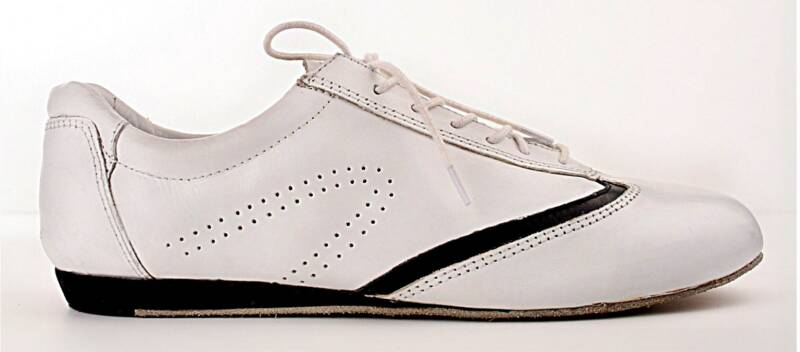
5) Practice sneakers (modern hybrid trainers)
Practice sneakers blend comfort with dance functionality. Think of them as "all-day class shoes" for dancers who need support and durability.

Strengths
- Better cushioning for long training blocks.
- Better versatility across mixed surfaces.
- More protective than jazz shoes.
Weaknesses
- Some soles still generate too much friction for advanced spin work.
- Usually less elegant for dress-code socials.
- Some models wear unevenly and lose pivot quality.
These are often the best choice for dancers who train heavily, have foot sensitivity, or dance in inconsistent venue conditions.
Best use case: regular classes, workshops, and high-volume weekly training.
6) "Pointy" social style shoes and hard-sole fashion shoes
These are common in some salsa scenes where style and visual identity are part of the culture.

What dancers like
- Distinct, bold look.
- Good glide on certain wood floors.
- Works as a dual-purpose social shoe for dancing + nightlife.
Risks
- Footwork complexity can suffer due to long toe shape or stiff edges.
- Fatigue can increase over long dance nights.
- Quality varies wildly by brand and model.
They can absolutely work in the right hands, but they are usually better for dancers with solid fundamentals already.
Best use case: advanced social dancers who know exactly how the shoe behaves on their usual floors.
7) Modern suede salsa shoes (my top overall category)
When dancers ask for one category that balances performance, comfort, and style, this is usually it.


Why this category stands out
- Suede sole allows clean pivoting and controlled turns.
- Better fit and containment than ultra-thin minimalist shoes.
- Often stylish enough for congress nights and social events.
- Good compromise between technical function and aesthetic finish.
What to watch
- Suede requires brushing and maintenance.
- Not ideal for outdoor walking.
- Cushioning varies; some dancers add thin gel or orthotic inserts.
For male dancers serious about salsa social dancing and cleaner spinning, this is typically the best long-term investment.
Best use case: intermediate/advanced socials, congress floors, and dancers building consistency in spins and musical footwork.
Surface matters more than most people realize
A "great" dance shoe can feel terrible on the wrong floor.
Wood dance floor
- Usually best for suede soles.
- Great for controlled pivoting.
Sticky club laminate
- Can feel grabby with rubber.
- Suede may still work, but check before committing to triple spins.
Concrete or outdoor venue
- Protect your suede; use a more durable sole.
- Consider hybrid practice sneakers.
Unknown venue
Bring two options when possible: one suede-based, one hybrid. The ability to adapt can save your knees.
A realistic buying framework by level
If you're overwhelmed by options, this framework works.
Beginner (0-6 months)
- Prioritize comfort + basic pivot ability.
- Budget-focused options are fine.
- Avoid extremely stiff, heavy shoes.
Intermediate (6-24 months)
- Upgrade to better suede behavior and cleaner turns.
- Start matching shoes to venue type.
- Focus on consistency in weight transfer and balance.
Advanced/social regular
- Optimize by use case: training vs social vs performance.
- Keep at least two shoe types.
- Replace before the sole quality collapses.
Common mistakes men make when buying salsa shoes
- Buying only for looks.
- Ignoring floor type.
- Choosing shoes that are too loose.
- Blaming shoes for technique gaps.
- Using one pair for every context.
- Waiting too long to replace worn soles.
Buyer profiles: what to buy based on your weekly dance life
Most men do better when they shop by usage profile instead of brand hype. Use these profiles to make a smarter first purchase.
Profile A: class-focused beginner (1-2 classes/week)
If most of your dancing is in beginner classes and occasional socials, prioritize stability and affordability:
- Start with a supportive jazz shoe or a lightweight dance sneaker.
- Skip ultra-minimal shoes until your balance and spotting improve.
- Keep your budget moderate and put the rest into classes and private feedback.
Why this works: new dancers improve fastest from repetition and correction, not premium footwear.
Profile B: social-first dancer (2-4 socials/week)
If you dance long nights in clubs and congresses, fatigue management matters:
- Choose a suede-friendly social shoe that balances comfort and spin control.
- Carry a second pair if local venues vary from smooth wood to sticky laminate.
- Rotate shoes so one pair can dry and recover between nights.
Why this works: comfort and consistency over multiple hours prevents technique breakdown in the last hour of the night.
Profile C: heavy trainee (classes + practice + socials)
If you train hard and log many dance hours weekly:
- Keep one training shoe (more cushioning/support).
- Keep one social/performance shoe (lighter, faster, cleaner pivots).
- Replace worn pairs proactively to avoid chasing old habits caused by dead soles.
Why this works: different training contexts ask for different shoe behavior. One pair rarely optimizes all contexts.
Knee, ankle, and foot health: shoe choices that reduce risk
Salsa dancers often think only about spinning speed. Long-term progress depends on joint health.
If you get knee pain during turns
- Check whether your sole is too sticky for your venue.
- Reduce forced torque by cleaning/maintaining soles.
- Build turning mechanics (core, spotting, controlled prep) instead of forcing momentum.
If your arches fatigue quickly
- Try a model with better midfoot support.
- Add a thin insole compatible with dance shoes.
- Use training shoes for long rehearsal blocks and switch to lighter shoes for social sets.
If your toes get crushed in crowded socials
- Avoid paper-thin shoes in packed venues.
- Choose a toe box that protects without becoming bulky.
- Keep posture and spatial awareness; no shoe can fully protect bad floorcraft.
This is the practical rule: the best salsa dance shoes for men are the shoes that keep you dancing pain-free month after month.
A practical comparison matrix (real-world priorities)
If you like quick decisions, use this matrix. Ratings are relative and assume proper fit.
| Shoe Category | Spin Control | Comfort (Long Night) | Foot Protection | Style for Socials | Best For |
|---|---|---|---|---|---|
| Street Shoes | Low | Medium | High | Low-Medium | Absolute beginners testing the waters |
| Dance Sneakers (Bloch-style) | Medium-Low | High | Medium | Low | Classes and transitional phase |
| Jazz Shoes | High | Medium | Low | Low | Technique training and studio work |
| Latin Ballroom Shoes | High | Medium | Medium | High | Performance and polished socials |
| Practice Sneakers | Medium | High | Medium-High | Medium | Heavy class schedules |
| Pointy/Hard-Sole Fashion | Medium | Medium-Low | Medium | High | Style-heavy advanced socials |
| Modern Suede Salsa Shoes | High | High | Medium | High | Best overall long-term salsa use |
No table can replace trying shoes on your own feet, but this can narrow your shortlist fast.
Budget strategy: spend smarter, not just more
A common mistake is overinvesting too early in one expensive pair.
A better strategy:
- Buy one dependable training pair first.
- Dance in them for 2-3 months and track what you dislike (grip, fatigue, support, heat).
- Buy your second pair based on those real notes.
This approach usually produces better outcomes than buying a premium shoe based only on social media recommendations.
If your budget is tight, invest in: - better fit, - better sole behavior, - and more class volume.
Those three beat luxury branding every time.
Fit guide for men's salsa dance shoes
When trying on shoes, test these movements:
- Basic forward-and-back step for stability.
- Slow single right/left turns for pivot comfort.
- Quick side-to-side weight transfers.
- Light shine pattern with small directional changes.
What you want to feel: - heel secure, - forefoot stable, - no painful pinching, - no internal sliding during turns.
If fit is close but not perfect, test with dance socks and, if needed, a thin insert. Avoid "hoping it stretches" if the shape is wrong.
Maintenance: make your shoes last and perform better
- Brush suede soles regularly.
- Keep shoes dry and aired out.
- Do not wear suede shoes on sidewalks.
- Rotate pairs if you dance often.
- Replace before the sole becomes unpredictable.
A well-maintained mid-range shoe can outperform an expensive neglected one.
What about style and color?
Yes, style matters. Salsa is social and visual. But style should support function.
If you love white shoes because they highlight footwork, great. Just remember lighter shoes draw attention to every timing error too. Darker tones are usually more forgiving on busy club floors.
My practical advice: keep one neutral pair for most nights and one "statement" pair for special events.
Final recommendations (simple and honest)
If you are a beginner looking for value, start with jazz shoes or a practical dance sneaker.
If you dance frequently and want one strong all-around option, modern suede salsa shoes for men are usually the best overall choice for social dancing, turning comfort, and style.
If you perform regularly, keep a dedicated performance pair and a separate training pair.
And if you are still in street shoes, that is fine for now. Just understand the ceiling. As your dancing improves, your shoes should stop fighting your movement.
FAQ: men's salsa dance shoes
Do I need expensive salsa shoes to dance well?
No. Better technique always beats expensive gear. But a shoe with the right sole and fit helps you apply technique more consistently and safely.
Are suede soles mandatory for salsa?
Not mandatory, but very useful on many indoor floors. They usually provide the best balance for controlled turning and stopping.
Should men use ballroom heels for salsa?
Some dancers love them, especially for performance and polished socials. Others prefer flatter profiles. It depends on your mechanics and goals.
How often should I replace dance shoes?
Depends on usage and floor conditions. If spin control changes, edges collapse, or cushioning is gone, it is time.
Can I use running shoes for salsa?
Usually not ideal. Running shoes are built for forward motion and traction, not pivoting. They can increase torque on knees during turns.
What's the best salsa dance shoe for men with flat feet?
Look for models with better support and room for inserts. Hybrid practice shoes or supportive modern suede models are often a good fit.
Closing thought
Shoes will not create rhythm, timing, or connection. But they can absolutely remove friction between what you hear and what your body tries to do.
That is why this topic matters.
If you are serious about improving salsa footwork, musicality, and social stamina, treat shoes like part of your training system, not just a fashion accessory.