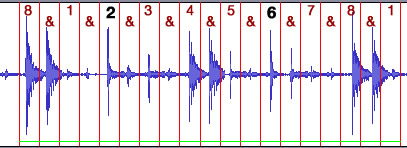
I am very happy to have found out that interest in learning to dance on2 (NY/PR) timing has started becoming very popular on addicted2salsa.com. To help everyone become more familiar with the clave and the VERY important conga slap, I have edited the original salsa clave track I created in Garageband for Episode 25 : Finding the Salsa Beat and modified it for an easier learning experience. This should help everyone make it part of their daily schedule to play the track at least 3 times a day while they do some other task. Doing this will allow your brain to sink-in that conga beat and rhythm subconsciously - so that it starts becoming easily recognizable by your ears.
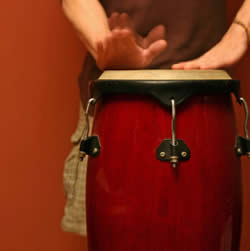
At first, I recommend forgetting about the clave when listening to the soundtrack. Focus on the ‘tu-ku (small pause) PA!’ (conga) sound first. The ‘tu-ku’ sound happens on the 8-AND and 4-AND counts. That ‘PA’ sound are your 2′s and 6′s when dancing on2.
I have loaded the waveform of the track and added some cue markers for you to understand what is happening in the beat. You can do the same with any audio editing program, for example, the free Audacity. Please remember that this is not a perfect graph of the waveform, but it is very accurate if you focus your attention on the peak points. (No noise reduction or normalizing was done).
The exercise video (recommended) is posted here : Salsa Beat and Rhythm Exercise.


The clave sound 3/2 to me, therefore I think the numbers are not correct.
I don’t think the clave \numbers\ matter in the graph as much as the numbers of where the conga sounds. You could rearrange the numbers as you’d like, but the sounds at (8-AND, and 4-AND) would still be the same. I think Anthony is asking us to focus on those sounds first to get to know the conga before we get to know the clave.
yes, indeed, for me too it doesn’t matter much for the purpose of dancing…:-)
I have found out that whatever the clave is, the 2-3 in NY Style(basic backward) should always match the 2 of the clave. Keeping this as a rule you actually have a different dancing feeling when the song’s clave is in 2/3 or 3/2.
Seeing it in this way the numbers in the graphic are correct.
The beat numbers on the two measure dancer’s phrase (8 counts) will not change whether the clave is 3/2 or 2/3. The count is related to the start of the song and it’s chord progression.
This example is meant to illustrate the fact that the slap of the conga pattern will always be on beat 2 of a measure. I you group together two measures to conform to an 8 beat dancer’s phrase then slaps occur on the 2 and 6.
Now, the idea that the back break of the basic should always match the 2 hit side of the clave is a personal preference. However, most people do not make this distinction and it would require dancers to always identify whether a clave is 3/2 or 2/3, which is kind of difficult for the average person. In particular on songs where there is no explicit clave pattern (the instrument) being heard. This also requires the correction of your step whenever a song changes the direction of the clave. Few people would bother with this, not even Eddie Torres (many people take his teaching as THE norm).
In his timing CD, ET describes that the man should start his basic step so that he breaks forward on the 6 beat of the phrase. Of course, on the 2 one would break back, but he doesn’t mention any relation of forward or back breaks as related to whether the clave is 2/3 or 3/2.
(This way of starting on the 6 was a new concept I hadn’t heard before about the ET style, as most people would just let the song get all the way to the next beat “2″ to break back. This method is interesting in that you hear the song begin and you just need to wait out the first measure and start forward on the second measure, as opposed to wait until the third measure to break back when the next “2″ comes around.)
Hi,
Pratically in dancing in couple I agree with you, but theorycally I tend to go further then this because I don’t think I have found yet many very good NY dancers and in dancing alone in shines the following matters a lot.
I have found out that the clave is very essential in dancing NY. NY style in fact is a style that can be danced with enphasy on all the instrument playing, not just on the main ones, like in LA or Cuban(except Son), and this is a great liberation from counting, because you just listen to the instruments, knowing how to listen to them. This allow to be IN the song, like a player in it, and therefore express much more union with the music. If you don’t consider the clave you still need to count!
This presuppose to know and ear very well how the clave is playing, where all other instruments turn around. I haven’t seen the timing cd from ET, only the video with the chart and the congero. I am actually surprised that Eddie Torres and also Thomas Guerrero don’t consider the clave in their presentation and i don’t consider them absolutely great on-line teachers. The conga reference is very limited, first because the conga is hardly udible, and second because the tumbao runs the same every measure(unlike the clave), therefore adding not much extra feeling for the music. Anyway having an awareness of the conga is already a big conquest in dancing salsa, also because it is the one that is most in touch with the clave.
The clave instead joins 2 measures, and is a rhythmic instrument, not only timinig. And gives syncopation to salsa that newbes can enjoy spontaneously without knowing anything about timing and instruments. Therefore a conscious knowing of this instrument and how it relates to all the others will really give you a boost in your dancing proper salsa.
In this point of view it is for me essential to know where in the clave I am having my 2.
I cannot yet say, though, how i can control my moves when the clave is 2/3 rather thatn 3/2, because I think both the persons of the couple have to have this awareness, and dancing solo I haven’t yet acquired a counscious control about this, eventhough I can notice the effect.
Therefore I don’t consider this particular respect meaninful in my practising and discovery of dancing.
Nice talking to you!!
Hello Andrea,
“If you don’t consider the clave you still need to count!”
- I believe that “listening to the clave” and “counting” are just two ways of doing the same thing. You are just listening for cues in the music that will tell you where you are in the pattern and at what beat you are stepping so as to validate you are still on time. So, if you count 1,2,3,4,5,6,7,8 to recognize the “2″, or listen to the conga slap to recognize the “2″ or listen to the clave to recognize the “2″ or the “6″, they are just shortcuts to the same understanding.
With experience, a dancer will not consciously try to identify or count the beats throughout a song, but most people will do this occasionally in order to ensure they are on the beat and haven’t strayed from it.
“This presuppose to know and ear very well how the clave is playing, where all other instruments turn around. I haven’t seen the timing cd from ET, only the video with the chart and the congero. I am actually surprised that Eddie Torres and also Thomas Guerrero don’t consider the clave in their presentation”
- I am not surprised the teachers don’t consider the clave in the demonstrations, because the basic step is taught in relation to the 8 beat phrase and stepping the same way without regard to the clave being 2/3 or 3/2.
“The conga reference is very limited, first because the conga is hardly udible,”
- I don’t find the conga hardly audible. The conga is present in all salsa songs except for portions of music breaks, “bloques” (don’t know term in English), etc. Actually, even if the conga is not heard well, our minds can fill the tumbao pattern in and signal us where the beats are.
On the other hand, the clave is sometimes very quiet and very often not played at all by using clave instrument (wooden sticks). In absence of the stick pattern, one would have to listen for clues of the clave being used in the melody lines of the bass, piano, singer, etc. This is much harder than using the conga as a reference or counting from 1 to 8. Even professional musicians can on occasion mistake the direction of the clave. Incidentally, if you ask the public to clap to the clave, they’ll clap a 3/2 most every time, while most songs are 2/3. Try it.
“and second because the tumbao runs the same every measure(unlike the clave),”
- But this is all most people need because they just want to identify the second beat of each measure (2 or 6).
“having an awareness of the conga is already a big conquest in dancing salsa, also because it is the one that is most in touch with the clave.”
- I wouldn’t say “the one”. Since the conga plays the same pattern over a four beat measure, I believe the bass will more closely follow the clave pattern as it plays close to it on both measures of the clave pattern.
In this point of view it is for me essential to know where in the clave I am having my 2.
- Well, having your “2″ or “6″ depending on the direction of the clave. What I believe you mean is that you believe you should always break in the same direction (fwd or back as you choose) on the “2″ of the two hit measure of the clave. (which can be 2 or 6 of the dancer’s phrase, depending on clave direction).
I cannot yet say, though, how i can control my moves when the clave is 2/3 rather thatn 3/2, because I think both the persons of the couple have to have this awareness,
- Yes, they need to be ready to change their forward or back breaks to sometimes on the 2 and sometimes on the 6 depending on the clave – and even adjusting within the same song using a kick or touch or other step.
Anyway, if it’s important for you to go to the limits of interpreting in relation to the clave direction, and you can have a partner be aware and willing to follow that lead, then it’s something you should go for and have fun doing it.
Hi Ivan,
Thanks for your reply. First I just want to let you know I am a leader, a man, not a woman… I know the name is mostly for women around the world.
Ivan sayd “- I believe that “listening to the clave” and “counting” are just two ways of doing the same thing. You are just listening for cues in the music that will tell you where you are in the pattern and at what beat you are stepping so as to validate you are still on time. So, if you count 1,2,3,4,5,6,7,8 to recognize the “2″, or listen to the conga slap to recognize the “2″ or listen to the clave to recognize the “2″ or the “6″, they are just shortcuts to the same understanding. ”
Andrea replies: You can count 1234etc.. because you know how to associate the numbers to the timining and therefore to the instruments. Therefore counting is just a mental reference not a real one. The instrument marking will tell you exactly where that beat is, while the mind counting is just an fake projection of the music you are listening. Removing counting is removing something you don’t need anymore, because you know how that is meant to be. The clave reference is every 8 beats, the conga slap reference every 4, therefore you have and advantage if you know the both, not just one.
I:”I am not surprised the teachers don’t consider the clave in the demonstrations, because the basic step is taught in relation to the 8 beat phrase and stepping the same way without regard to the clave being 2/3 or 3/2.”
A: Ok for a beginner that makes sense, but an advanced dancer wanna know every trick of the trade, don’t you agree? And I don’t think there can be a proper On2 dancer unless he can also dance properly On1.
I: “I don’t find the conga hardly audible. The conga is present in all salsa songs except for portions of music breaks, “bloques” (don’t know term in English), etc. Actually, even if the conga is not heard well, our minds can fill the tumbao pattern in and signal us where the beats are.
On the other hand, the clave is sometimes very quiet and very often not played at all by using clave instrument (wooden sticks). In absence of the stick pattern, one would have to listen for clues of the clave being used in the melody lines of the bass, piano, singer, etc. This is much harder than using the conga as a reference or counting from 1 to 8. Even professional musicians can on occasion mistake the direction of the clave. Incidentally, if you ask the public to clap to the clave, they’ll clap a 3/2 most every time, while most songs are 2/3. Try it.”
A: I have never noticed clearly the conga as essential before it was taught me to hear it when I have started dancing NY. Before I was dancing Cuban style for 2 years, and I was quite good at it. The clave is instead often clapped with hands, it starts alone in some measures of the song and is very acute, so much that just a reminder now and then is enough to feel it…and to address the musitian about the tempo.
Here as above is a matter of the level we want to reach. Before NY style I never needed much neither the clave nor the conga to dance a good salsa.
I don’t know if 23 clave is more common then 32, but as I told you before I don’t(or I haven’t learned to) see this as meaninful for the control, I just enjoy the difference in the effect.
I:- But this is all most people need because they just want to identify the second beat of each measure (2 or 6).
A: When I start I don’t look the clave, because I am never sure I am hearing it correctly…but I realize where I have my 2 after few measures, therefore I know I will always have to find my 2 in the same position.
I:”- I wouldn’t say “the one”. Since the conga plays the same pattern over a four beat measure, I believe the bass will more closely follow the clave pattern as it plays close to it on both measures of the clave pattern.”
A: I believe the conga is very close to the clave because the tumbao slaps and hits mark nearly every half beat, and need therefore a great precision.
Next week I will be attending the NY Salsa congress, and mayne I’ll come up with something new
))
Enjoy your Salsa!!
“First I just want to let you know I am a leader, a man, not a woman… I know the name is mostly for women around the world.”
- Ok.
Andrea replies: “You can count 1234etc.. because you know how to associate the numbers to the timining and therefore to the instruments. Therefore counting is just a mental reference not a real one.”
- This is like a philosophical issue I’ll skip.
“The instrument marking will tell you exactly where that beat is, while the mind counting is just an fake projection of the music you are listening. Removing counting is removing something you don’t need anymore, because you know how that is meant to be.”
- Regarding the counting and the instrument markings… The way I can explain is that in order to analyze or understand any piece of music regarding rhythm patterns and what any instrument does – whether for playing an instrument or dancing – there is a sequence of things one must know in this order.
1. Determine the tempo of the song,
2. Detect how many beats between accents occur – every 2, every 3, every 4, every 5, 6 or 7, etc. This will tell you what the music’s time signature is. Salsa, and most European music is in a 4/4 time, which means that the measures are 4 beats long with a recurring accent on the 1. (A waltz on the other hand is 3/4 with accent every 3 beats)
3. At this point, you can describe X or Y rhythm pattern, instrument hits or steps *in terms of the beat numbers you determined on step 2. Therefore, knowing how to count the beat is a pre-requisite to identifying and describing clave, tumbao or whatever, since you describe those patterns and events in terms of the beat numbers.
“The clave reference is every 8 beats, the conga slap reference every 4, therefore you have and advantage if you know the both, not just one.”
- Ok, I guess.
A: Ok for a beginner that makes sense, but an advanced dancer wanna know every trick of the trade, don’t you agree?
- Ok, although one must see what difference it makes in one’s dancing.
“And I don’t think there can be a proper On2 dancer unless he can also dance properly On1.”
- Hmmm…. I think someone can be a very accomplished dancer in any style and have difficulty dancing on another pattern/timing…just because of lack of practice in the other. Now, it is a very desirable skill to be able to dance in any pattern/timing.
A: “I have never noticed clearly the conga as essential before it was taught me to hear it when I have started dancing NY. Before I was dancing Cuban style for 2 years, and I was quite good at it.
- The conga is just used as the simplest way for beginners to identify the 2 and the 6 where they break because it is always present in the music…not that it’s essential if you already know to break on the 2 or 6 based on other cues or intuition.
“The clave is instead often clapped with hands, it starts alone in some measures of the song and is very acute, so much that just a reminder now and then is enough to feel it…and to address the musitian about the tempo.
Here as above is a matter of the level we want to reach. Before NY style I never needed much neither the clave nor the conga to dance a good salsa.”
- The need for the clave or conga probably arises in NY style because it is taught in a very strict way, requiring you to break back on the 2 and fwd on the 6. So dancer’s MUST EXACTLY identify the 2 and the 6 (and as a prerequisite, the 1 through 8). When one danced without taking lessons one would just break forward or back whenever, so people danced on the 1 or 3 mostly. Dancing on two requires more ear and music training as it is not what feels more “natural”.
“A: When I start I don’t look the clave, because I am never sure I am hearing it correctly…but I realize where I have my 2 after few measures, therefore I know I will always have to find my 2 in the same position.”
- If you know to identify the 1 (and are able to count the beats) it wont take a few measures. You would know in the first measure, without regard to clave pattern.
“I:”- I wouldn’t say “the one”. Since the conga plays the same pattern over a four beat measure, I believe the bass will more closely follow the clave pattern as it plays close to it on both measures of the clave pattern.”
A: I believe the conga is very close to the clave because the tumbao slaps and hits mark nearly every half beat, and need therefore a great precision.”
- I am refering to an instrument matching the whole clave pattern, not just one hit. The conga hits something every 8th note (perhaps what you call a half beat) and the slap occurs on the 2 and 6. I don’t know if you know which beats the clave hits, but…
The slap mathces only one of the 5 hits of the clave…. The “2″ on the 2/3 clave (hits 2,3,4,5&,8) or the “6″ on the 3/2 clave (hits 1,2&,4,6,7)…so only one conga slap in two measures coincides with the clave pattern. The bass, however, will probably play four or all five hits of the clave pattern. Just listen to some songs; you should hear this and find it will let you know what clave direction the song is when there are no clave sticks or claps playing a clave pattern.
“Next week I will be attending the NY Salsa congress, and mayne I’ll come up with something new
))”
- Good, have fun.
I suggest away from the dance floor it would be good to read about music theory (tempo, identifying beats) and the rhythm patterns of the various instruments in typical salsa and be able to describe them in terms of the numbered beats. This is of course a mostly academic exercise, but very useful in communicating ideas to others and understanding what other people may talk about. Very often, people without musical theory training (even if they are “teachers”) may misuse the terms and confuse us if we are not up with the theory. After we learn, we’ll be surprised at how often it happens. I could give a coule of examples, but it could get too technical.
An example of this is that Eddie Torres himself tells us that he was dancing for years and performing, but he didn’t know any music theory and wasn’t able to correctly explain himself while teaching until they sat him down and helped him learn the theory.
Later.
I:- Regarding the counting and the instrument markings… The way I can explain is that in order to analyze or understand any piece of music regarding rhythm patterns and what any instrument does – whether for playing an instrument or dancing – there is a sequence of things one must know in this order.
1. Determine the tempo of the song,
2. Detect how many beats between accents occur – every 2, every 3, every 4, every 5, 6 or 7, etc. This will tell you what the music’s time signature is. Salsa, and most European music is in a 4/4 time, which means that the measures are 4 beats long with a recurring accent on the 1. (A waltz on the other hand is 3/4 with accent every 3 beats)
3. At this point, you can describe X or Y rhythm pattern, instrument hits or steps *in terms of the beat numbers you determined on step 2. Therefore, knowing how to count the beat is a pre-requisite to identifying and describing clave, tumbao or whatever, since you describe those patterns and events in terms of the beat numbers.
A: Well that is a good explanation, I wouldn’t know how to describe it better. For me counting now is significant only in order to learn a pattern or shines, because it helps me to break down the beats corresponding to the steps. But I can’t use counting anymore once I have learned the pattern because it slows me down and I feel like I am dancing mechanically. Once again practise is the key and counting is what helps practising.
Of course counting is very useful when dancing with a beginner, because you can communicate it to your partner but in NY Style it is quite tricky to do so with easy numbers, because it is a style requiring great enmeshing of the body with the music, it requires precision. Even the mambo (234-678) requires you to locate the 2, but not the 1 with the same precision, as in NY style. There is only 1 beat between the 1 and the 2 and yet this is not easy to accomplish for a beginner. In this case, for what I can see from people learning it, they will have to anticipate the 1(like in mambo) or arrive late on the 2(tending to dance salsa on3 therefore), and therefore they tend to lose the timing very easily; until they get the holy clave to regulate their timing.
I never suggest someone who wants to learn salsa to apply for a NY style class, it requires too much effort without first having a feeling with the downbeats(1and 3), that you can easily learn in Cuban Style.
I:- The conga is just used as the simplest way for beginners to identify the 2 and the 6 where they break because it is always present in the music…not that it’s essential if you already know to break on the 2 or 6 based on other cues or intuition.
A: Here again the more references you can have in your dancing the more secure you will be in your dancing because you can swap your focus between the instruments in the case
-you can’t hear anymore the one you were just following
-to change expression of the body
-to have a clear insight about what will be your next steps so that you can give more expression to each move. In this regards I can tell you that even the clave is not much helpful anymore and I have to find patterns in the music being played that allows me to know more about my future moves. If, for instance the same piano or cowbell pattern repets itself more then once, spanning for instance 4-5 measures, that is of great enjoyment for me!! In this case I “map” my 2 or my 1 or my 6, etc., to the same point in this pattern, so that it feels more like a coreography.
I:- The need for the clave or conga probably arises in NY style because it is taught in a very strict way, requiring you to break back on the 2 and fwd on the 6. So dancer’s MUST EXACTLY identify the 2 and the 6 (and as a prerequisite, the 1 through 8). When one danced without taking lessons one would just break forward or back whenever, so people danced on the 1 or 3 mostly. Dancing on two requires more ear and music training as it is not what feels more “natural”.
A: Exactly. NY style requires precision like that of a player in the salsa band, with the difference you can swap between all the instrument…that is what is great in this salsa!
I never liked though the non-naturality of this style, and is for this reason I am getting to know more about it, remove the counting, etc., so that I can dance it more freely.
I:- If you know to identify the 1 (and are able to count the beats) it wont take a few measures. You would know in the first measure, without regard to clave pattern.
A: Ok. here what I wanted to make clear is that the 1 can be the 5, but you are not very sure of it until you identify the clave; that is to know if the 1 you take for granted is on the measure of the 3 clave beats or on the following of the 2 clave beats. Sometimes I really need more that few measures to make this sure. This has nothing to do with whether the clave is 3-2 or 2-3.
I:- I am refering to an instrument matching the whole clave pattern, not just one hit. The conga hits something every 8th note (perhaps what you call a half beat) and the slap occurs on the 2 and 6. I don’t know if you know which beats the clave hits, but…
The slap mathces only one of the 5 hits of the clave…. The “2? on the 2/3 clave (hits 2,3,4,5&,8) or the “6? on the 3/2 clave (hits 1,2&,4,6,7)…so only one conga slap in two measures coincides with the clave pattern. The bass, however, will probably play four or all five hits of the clave pattern. Just listen to some songs; you should hear this and find it will let you know what clave direction the song is when there are no clave sticks or claps playing a clave pattern.
A: Playing every half beat(8 beats or notes per measures,with a slap on 2 and 6) we are sure the conga matches all the clave beats, where it is clear the slaps matches only one of the five clave beats. If you consider the conga you have to look at all the noise it makes, not only slaps, right?
I see the bass as much as the piano matching most the clave, but not for sure as with the conga. All the instruments, have to go back to the clave anyway when they start solo and have then to get back in track.
I: I suggest away from the dance floor it would be good to read about music theory (tempo, identifying beats) and the rhythm patterns of the various instruments in typical salsa and be able to describe them in terms of the numbered beats. This is of course a mostly academic exercise, but very useful in communicating ideas to others and understanding what other people may talk about. Very often, people without musical theory training (even if they are “teachers”) may misuse the terms and confuse us if we are not up with the theory. After we learn, we’ll be surprised at how often it happens. I could give a coule of examples, but it could get too technical.
An example of this is that Eddie Torres himself tells us that he was dancing for years and performing, but he didn’t know any music theory and wasn’t able to correctly explain himself while teaching until they sat him down and helped him learn the theory.
A: I agree NY style requires good teachers. I have lost a lot of time listening to teachers, that even if they look good dancing they don’t know what they are doing, or they can’t really translate it in to words. I started to get the timing when I started to play salsa at home with sticks, hands, and I still love to do it.
Later, mate!
Look for Eddie Torres’ CD called timing practice or something like that. Very helpful in identifying el \TUMBAO\ or the conga slap on the 2 and 6. It has a song that counts every beat of the music 1-8. Another 1,2,3 5,6,7. Another that just counts 1. Another that is geared to On2 that counts 2,3 and 6,7. And one with a 2/3 clave and another with a 3/2 clave. It also has a 30min practice soundrack with all of these songs together with no voice counting. Great CD!!! And kinda hard to come by, but I’ve seen it sold online.
This is a great post! I totally agree with the Anthony’s methodology. In my opinion, the tumbao rhythm is more important than the clave. People should ask “Do you dance on the Tumbao?”, as supposed to “Do you dance on the clave?”
Like I always say, Salsa On2 is about a feeling, not about looking better. The tumbao feeling is so fundamental in feeling Cha Cha, Mambo, and Salsa On2.
Hi…I like.
This is great! Now I really have to learn how to use all this technology! Do you think you could show at some point a quick demonstration of these beats — the footwork — to accompany this video (Find the Salsa Beat Soundtrack). Thanks!
In the song from Ismael Rivera “Dime PorQue” this Conga slap is highly ephasized.
I do not understand anything:-(
help, please!
hi guys!! I been dancing salsa since 1999 and….all the dances had be born to gives one more tool to be free, to express to know how does someboby feel..that’s all. I’m teching for long time, watching, dancing on 1, now I trying ON 2, there’s something silly as mistery, doesn’t matter as you be able to connect to your partner and music. Im still thinking the first beat come from the heart, AND I can’t even count my hearts beats!!!
the best dancers and musicians aren’t the one’s who can explain from where or when the music is play more than a inside world.
@maia, You have a good point. However, just like there are different dialects of Spanish around the word, there are different dialects of Salsa around the world: Salsa On1, Mambo (Salsa On2), Cali Salsa, Casino Rueda, Salsa Cubana, Salsa de Barrio, etc. The ability to know whether you are following the Clave or Conga (dancing on2), or the Bongo Bell (dancing on1) in a salsa song are essential in order to connect with your partner when dancing a particular dialect of salsa. Part of dancing is being able to dance in “sync” with your partner in order for you and your partner to carry a ‘musical conversation’ when dancing. For this to happen, it requires that the leader and the follower “agree” on which musical instrument they will be following in order to enjoy the song together and play with each other’s moves to the music. Dancing On1 or On2 is just a personal preference of some dancers: Some like a hard down beat (similar to hip hop), others like the up beat (a.k.a the response) when dancing to salsa music.